
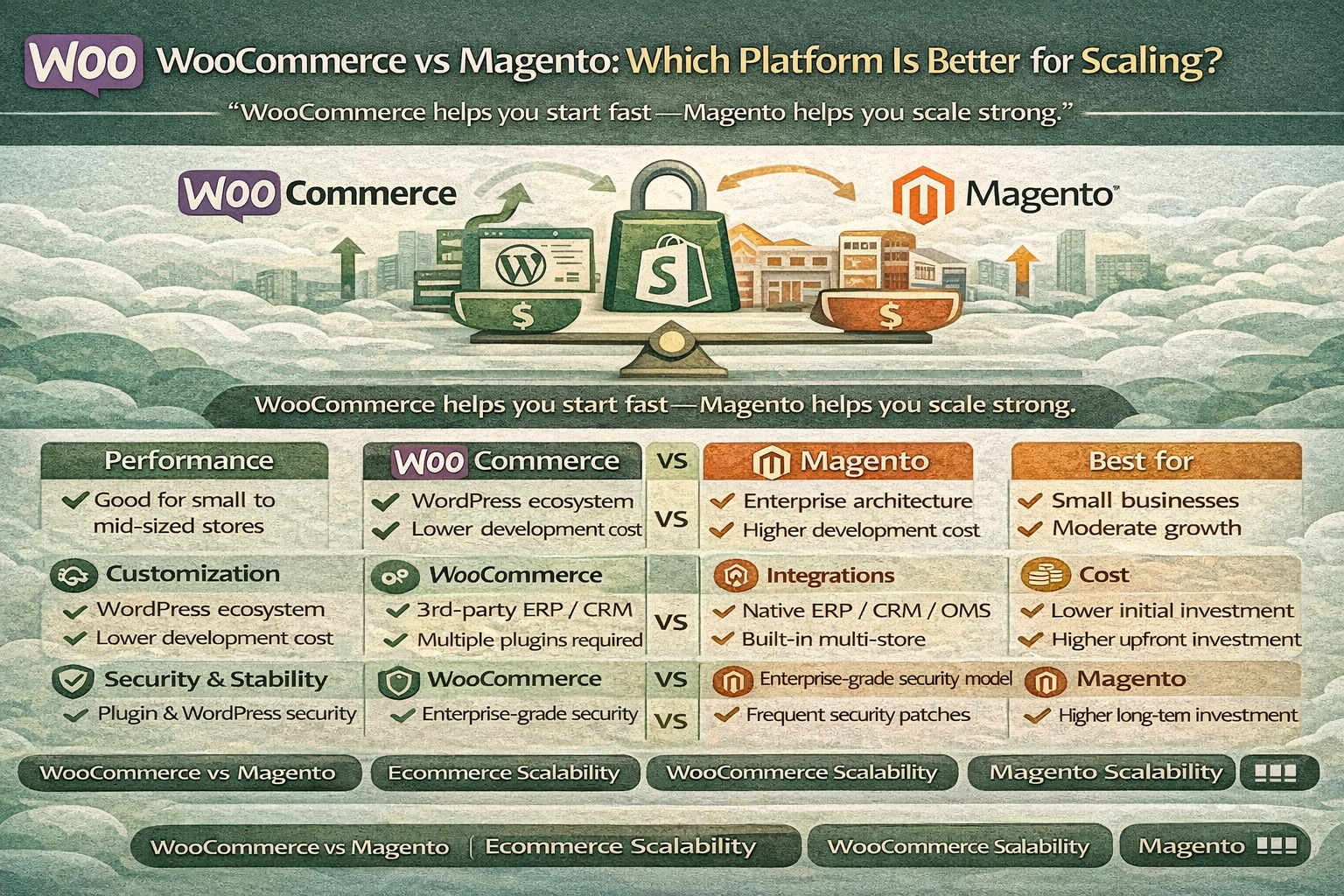

Choosing the right ecommerce platform is one of the most critical decisions for long-term business growth. While both WooCommerce and Magento are powerful solutions, their approach to scalability is fundamentally different.
This guide compares WooCommerce vs Magento from a technical, operational, and business scalability perspective — helping growing brands make the right choice.
“Scaling ecommerce isn’t about adding features — it’s about choosing an architecture that grows with you.”
Understanding Ecommerce Scalability
Ecommerce scalability means the platform can handle:
- Increasing traffic
- Growing product catalogs
- Higher order volumes
- Multiple integrations
- Global customers
- Peak sales events
The true difference between WooCommerce and Magento lies in how they handle growth under pressure.
Platform Overview
WooCommerce
- Built on WordPress
- Plugin-based architecture
- Open-source
- Ideal for small to mid-sized businesses
- Highly flexible with extensions
Magento (Adobe Commerce)
- Purpose-built ecommerce platform
- Modular architecture
- Enterprise-ready
- Designed for complex catalogs
- Advanced native features
WooCommerce vs Magento: Architecture Comparison
| Feature | WooCommerce | Magento |
|---|---|---|
| Core base | WordPress plugin | Standalone ecommerce framework |
| Architecture | Plugin-driven | Modular & service-oriented |
| Database load | High on scaling | Optimized for large datasets |
| Code complexity | Moderate | Advanced |
| Enterprise readiness | Limited | Native |
Magento is built for scale from the ground up, while WooCommerce extends WordPress beyond its original intent.
Performance & Traffic Handling
WooCommerce Performance
Pros:
- Easy optimization
- Lightweight for small stores
- Works well with caching & CDN
Cons:
- Heavy database usage
- Performance degrades at scale
- Requires strong server optimization
Magento Performance
Pros:
- Built-in full-page caching
- Advanced indexing
- Optimized for large catalogs
- Handles high concurrency
Cons:
- Requires powerful hosting
- Higher infrastructure cost
“WooCommerce can scale — Magento is designed to scale.”
Product & Catalog Scalability
WooCommerce
- Best for small to medium catalogs
- Performance slows with 50k+ products
- Heavy reliance on postmeta tables
Magento
- Designed for massive catalogs
- Handles 100k+ SKUs efficiently
- Native indexing and attribute system
For large inventories, Magento offers superior stability.
Customization & Development Flexibility
WooCommerce
- Easy customization
- Large WordPress ecosystem
- Faster development
- Lower development cost
Magento
- Highly customizable
- Requires expert developers
- Longer development cycles
- Higher technical complexity
“WooCommerce prioritizes flexibility — Magento prioritizes structure.”
Integration & Enterprise Features
WooCommerce
- Third-party plugins for ERP, CRM, OMS
- Requires multiple extensions
- Integration quality varies
Magento
- Native support for:
- Multi-store
- Multi-language
- Multi-currency
- Advanced pricing rules
- B2B functionality
Magento is better suited for enterprise workflows.
Security & Stability
WooCommerce Security
- Depends heavily on plugins
- Requires continuous hardening
- WordPress vulnerabilities can affect stores
Magento Security
- Dedicated security patches
- Enterprise-grade security model
- Strong access control
Magento offers stronger default security for large operations.
Cost of Scaling
WooCommerce Scaling Costs
- Lower starting cost
- Increases with:
- Hosting
- Caching tools
- Performance plugins
- Maintenance
Magento Scaling Costs
- Higher upfront cost
- Higher hosting requirements
- Professional development needed
“WooCommerce costs less to start — Magento costs less to outgrow.”
Which Platform Is Better for Scaling?
Choose WooCommerce If:
- You are a small or mid-sized store
- Product catalog is limited
- Budget is moderate
- You want fast development
- You rely on content marketing
Choose Magento If:
- You expect rapid growth
- You manage large catalogs
- You need enterprise features
- You require advanced pricing & inventory
- You plan global expansion
WooCommerce vs Magento: Final Verdict
| Business Stage | Recommended Platform |
|---|---|
| Startup | WooCommerce |
| Small business | WooCommerce |
| Growing brand | WooCommerce / Magento |
| High-traffic store | Magento |
| Enterprise | Magento |
There is no “best” platform — only the right platform for your scale.
“WooCommerce helps you start fast — Magento helps you scale strong.”
Conclusion
The debate of WooCommerce vs Magento ultimately comes down to scalability goals.
WooCommerce excels in flexibility, speed of development, and cost-efficiency for growing stores. Magento dominates in enterprise scalability, performance stability, and complex ecommerce operations.
Choosing the right platform early can save years of technical debt later.